





































Products tagged with 'metal earth'

MMS127
EASTERN COMMA
The Eastern Comma is native to Northeastern America. This butterfly is seasonally variable. The upper side of the summer form's hindwings are all black, whereas the winter forms hindwings are reddish orange. The underside of both forms is striped with dark and light brown. There is a silvery comma mark in the middle of the hindwing in both forms. Its wingspan is 4.5–6.4 cm (1.8–2.5 in).
$0.00

MMS126
MOURNING CLOAK
The Mourning Cloak is a large butterfly native to Eurasia and North America. This powerful flier is sometimes found in areas far from its usual range during migration. The Mourning Cloak has a lifespan of 11-12 months, one of the most extensive lifespans for any butterfly.
$0.00

MMS125
TIGER SWALLOWTAIL
The Tiger Swallowtail is native to eastern North America as well as Turkey. The male is yellow with four black “tiger stripes” on each forewing. Females may be either yellow or black, making them dimorphic. The yellow morph is similar to the male, but with a conspicuous band of blue spots along the hindwing, while the dark morph is almost completely black. This model is based off of the female yellow morph.
$0.00

MMS124
BUCKEYE
The Buckeye is found in southern Manitoba, Ontario, Quebec, and Nova Scotia; all parts of the United States except the Northwest.. The bold pattern of eyespots and white bars on the upper wing surface is distinctive in much of its range. The eyespots likely serve to startle or distract predators, especially young birds.
$0.00

MMS117
THE OLD MAN & THE SEA BOOK SCULPTURE
The Old Man and the Sea is a novel by Ernest Hemingway tells the story of a battle between an aging, experienced fisherman, Santiago, and a large marlin.
$0.00
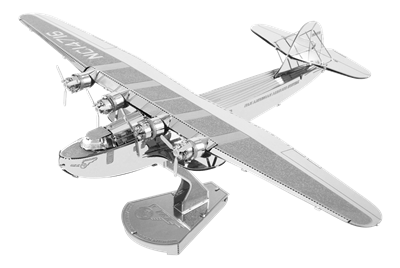
MMS103
PAN AM CHINA CLIPPER
China Clipper (NC14716) was the first of three Martin M-130 four-engine flying boats built for Pan American Airways. In November of 1935 it was used to inaugurate the first commercial transpacific air service from San Francisco to Manila by way of Honolulu, Midway and Wake Island. It continued to fly the Pacific for the next eight years carrying approximately 3,500 passengers and 750,000 lbs of mail and freight.
$0.00